
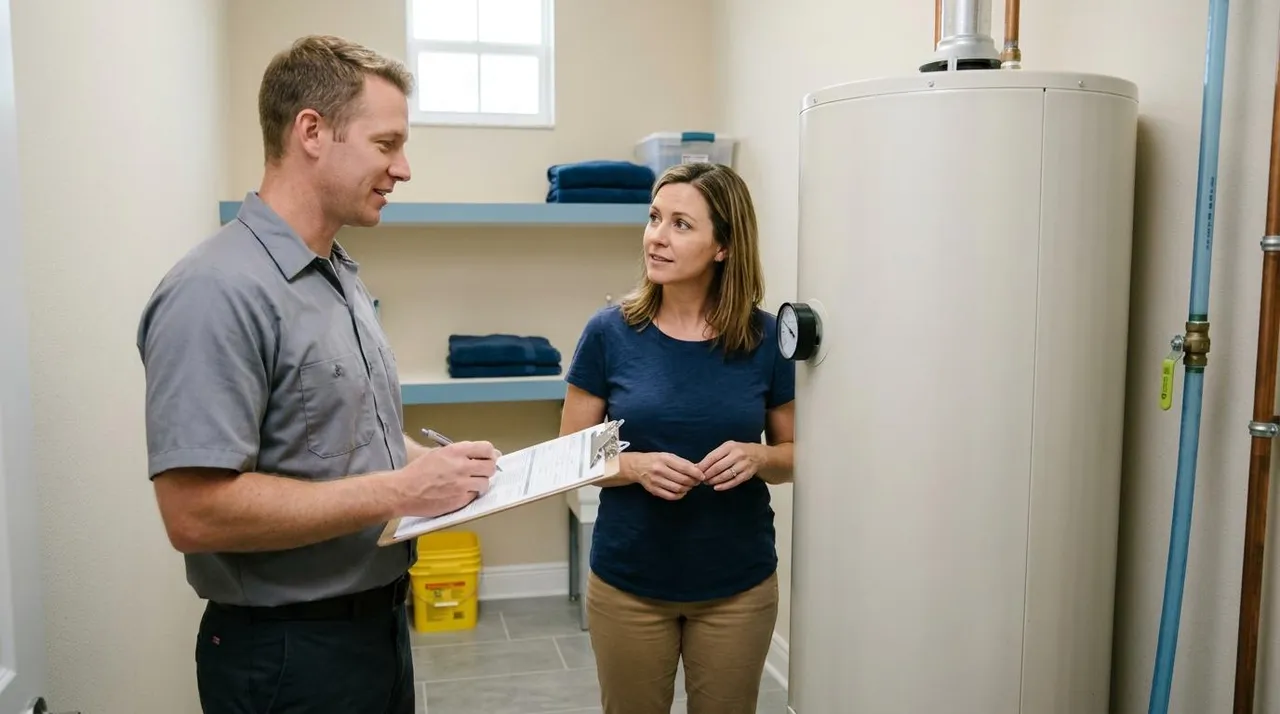
If you’re asking, “Should I repair or replace my water heater?”—repair may make sense when one replaceable part failed and the tank is otherwise sound. If the tank itself is leaking or corroded, failures keep returning, or the repair quote approaches the cost of a new installed unit, replacement deserves serious consideration. Age matters—but no age cutoff or “50% rule” can decide every case.
The right answer comes from identifying what failed, then comparing the likely life and cost of each option. Use this guide to sort the signs, prepare the right questions, and avoid committing to a repair or replacement before you understand the diagnosis.
Key takeaways
- Repair can make sense when the tank is sound and the issue is a limited, replaceable part, as outlined in A. O. Smith’s repair guide.
- Replacement is more likely when the tank itself is leaking or corroded, failures keep recurring, or performance is declining, signs discussed in Rheem’s guide.
- Age ranges and the 50% rule are guides, not guarantees. Compare the actual diagnosis and written estimates.
- Ask for both options—an itemized repair and a complete installed replacement quote—before deciding.
Should I repair or replace my water heater? Start with what failed
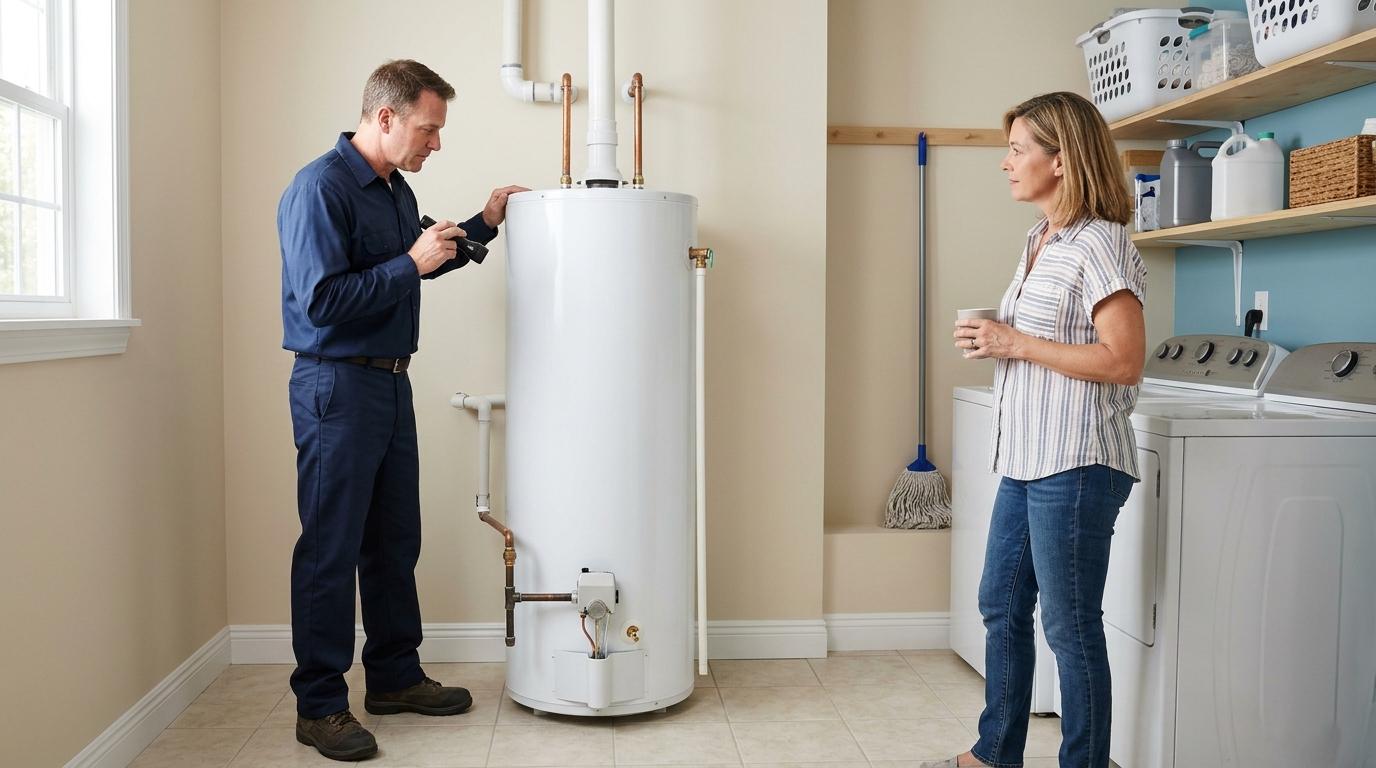
The first question is not “How old is it?” but “What part failed, and is the tank itself still sound?” A thermostat, heating element, or some valves and fittings may be repairable. A tank that has rusted through or is leaking from its body is a different situation; a component repair cannot restore a failed tank.
A. O. Smith’s repair-or-replace guide distinguishes common component problems from internal tank issues, while Rheem’s decision guide includes tank leaks and repeated problems among replacement warning signs. The water source matters: a leak at a fitting or valve may have a different remedy than water coming through the tank itself, so don’t diagnose the location from a damp floor alone.
| What the inspection finds | What to consider |
|---|---|
| One failed, replaceable component; tank is sound; few prior problems | Compare a repair quote with the value of continued reliable service. |
| Leak from a connection or replaceable valve | Ask whether the leak is isolated and what repair will address it. |
| Tank body leaking, severe corrosion, or structural failure | Replacement is generally the practical path; ask the plumber to confirm the source. |
| Several failures or repeated service calls | Compare the total repair history and likely next repairs with a complete replacement quote. |
| Older unit, but no leak and a clearly limited fault | Age is a factor—not an automatic reason to replace. Compare condition, quote, warranty, and reliability. |
If water is actively escaping, address the leak promptly and keep clear of electrical or gas components. A qualified plumber can confirm whether the problem is the tank or a repairable part before you choose an option.
How old is your water heater? Treat lifespan as a clue, not a deadline
Age helps estimate risk, but it cannot tell you by itself whether repair is worthwhile. Rheem estimates a typical storage-tank water heater lifespan at about 8–12 years and tankless units at 15–20+ years. A. O. Smith gives an 8–12-year average service-life range and notes that installation, maintenance, design, and water quality affect the result.
Those are general estimates, not an expiration date, warranty promise, or prediction for your specific heater. A well-maintained older unit with a limited, affordable failure may still be worth repairing. A younger unit with a leaking tank or a serious safety concern may not be. Look at the model and serial number to verify approximate age, then combine it with condition, repair history, and performance.
Also consider the heater type. A tankless unit and a conventional tank unit have different life estimates and repair needs. Don’t apply a tank-unit age rule to a tankless system—or assume a unit is healthy simply because it is within a published range. The manufacturer’s manual and a technician’s inspection are better guides for the specific model.
Does the repair quote make replacement the better value?
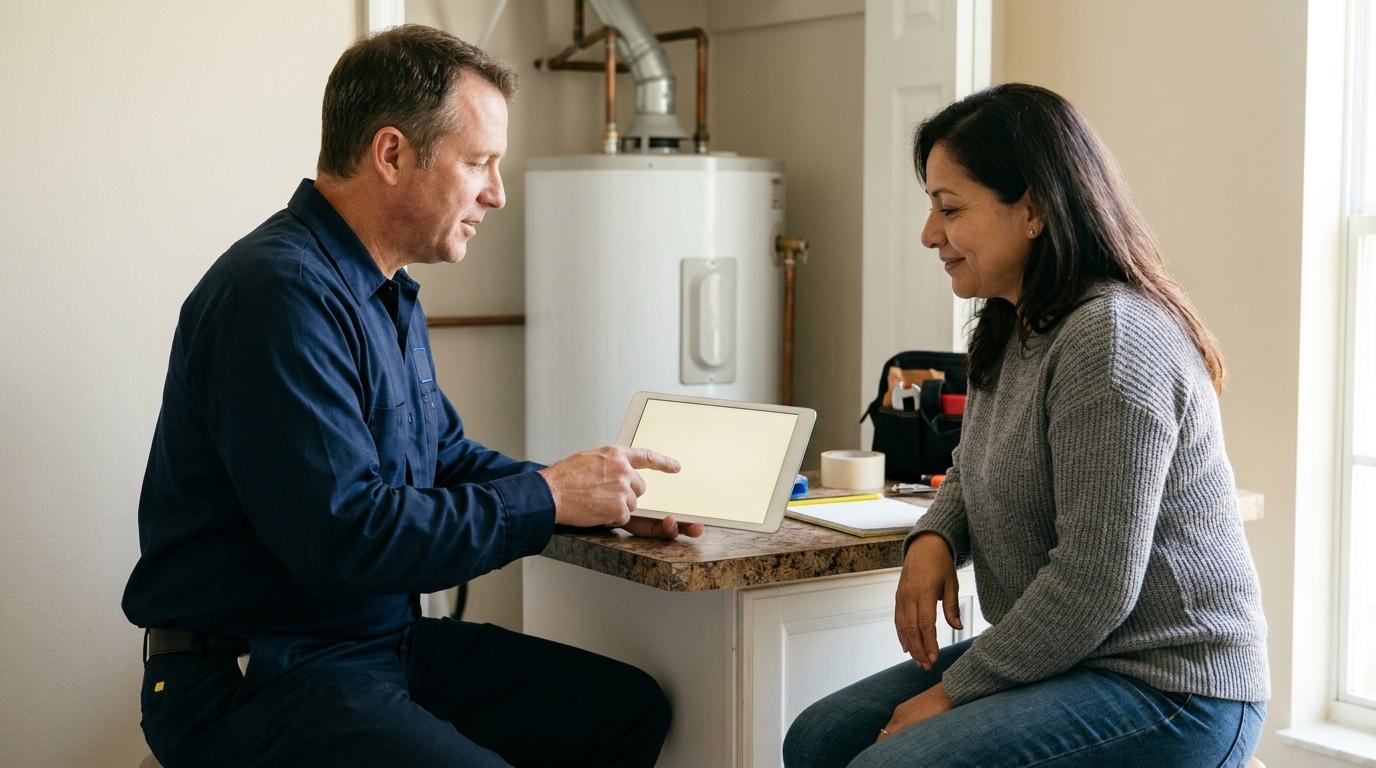
A repair quote is only half the comparison. Ask for the complete installed replacement price too, then compare what each option is expected to deliver: the repair’s scope and warranty, the unit’s condition, the likelihood of another failure, the new system’s warranty, and whether its capacity and operating efficiency fit the household.
Some consumer and manufacturer guides mention a “50% rule”—replace when a repair approaches half the price of a new unit. HomeTips presents that as a rule of thumb, and Rheem’s guide also treats repair cost as one factor. But it is not a universal plumbing standard. A 40% repair on a badly corroded, unreliable heater may be poor value; a repair above that rough threshold might still make sense for a newer unit with a sound tank and a clear, durable fix.
Use the percentage as a prompt to compare options, not as a verdict. Ask what is included in the replacement quote—equipment, installation, removal, required updates, and warranty—and what the repair quote covers. Don’t count an unverified rebate or predicted energy savings as guaranteed savings. If efficiency is part of the case for replacement, ask for the specific model’s energy information and compare it with your current system rather than relying on a broad promise.
There’s another cost that matters: disruption. If the current heater has repeatedly left the household without hot water, reliability may be worth more than the lowest immediate invoice. If it has been dependable and one part failed, a clear repair may avoid replacing a system that still has useful service life.
What should I ask before I agree to a repair or replacement?
A trustworthy decision starts with a clear explanation. Before you approve work, ask:
- What exactly failed? Ask the technician to identify the part or condition and show you the evidence where practical.
- Is the tank leaking, or is the leak at a connection or valve? The source can change the options.
- What does the repair include? Confirm the parts, labor, warranty, and what symptoms the work is expected to resolve.
- What is the full installed replacement price? Compare the total—not just the equipment price—with the repair estimate.
- What else is affecting the recommendation? Ask how age, prior repairs, hot-water reliability, warranty coverage, and household demand factor into the advice.
- Is there a safe repair option, and what are its tradeoffs? A useful recommendation should explain choices, not just present one unexplained outcome.
A. O. Smith recommends reviewing the unit’s warranty and nameplate information as part of the decision. Have the model and serial number, approximate age, symptoms, and recent repair history ready. If you’re in Palm Harbor or Pinellas County, Elite Plumbing is family-owned and explains clear options and upfront pricing before work begins. Its commitments—Transparent Pricing, No Surprises, 24/7 Emergency Availability, and Solutions That Last—are useful standards to look for when comparing estimates: cost clarity, help when a leak can’t wait, and a repair plan that addresses the cause.
Quick answers about water heater repair or replacement
Rheem and A. O. Smith both frame age, unit condition, and symptoms as relevant factors—not one fixed replacement rule. These are general answers; an inspection may change the recommendation for a specific heater.
Should I replace a water heater just because it is 10 years old?
No. Ten years is a useful prompt to check condition and repair history, not a universal deadline. Manufacturer estimates vary by type and model; consider the actual fault, whether the tank is sound, the repair quote, and reliability.
Can a leaking water heater be repaired?
It depends on where the water is coming from. A leaking tank body is a stronger replacement signal, while a fitting or valve leak may be repairable. Have a qualified professional identify the source rather than assuming from a puddle.
What is the 50% rule for water heaters?
It is a rough comparison guideline: if a repair costs around half the price of a replacement, compare the options carefully. It is not a guarantee that replacement is best; age, condition, warranty, installation cost, and likely reliability also matter.
Is it worth replacing a water heater that still works?
Sometimes homeowners plan ahead when an older unit is unreliable or a leak would cause major disruption, but a functioning heater does not automatically need early replacement. Compare the actual risk, current condition, household needs, and verified replacement cost before deciding.
A practical repair-or-replace checklist
This decision framework follows the factors emphasized in Rheem’s repair-or-replace guidance and A. O. Smith’s guide: the actual failure, unit condition, repair history, and cost of the options.
Repair is more likely to make sense when the tank is sound, the fault is limited to a replaceable component, the unit has been reliable, and the quote is reasonable for the expected service you’ll get.
Replacement deserves a closer look when the tank itself is leaking or severely corroded, repairs are recurring, performance is deteriorating, or the repair quote is close to the complete installed replacement cost. A newer, more efficient system may also fit better if the existing unit no longer meets the household’s needs—but verify the model, full price, warranty, and any claimed savings.
Do not let one age number or one percentage make the decision for you. Use them to frame questions, then compare the documented diagnosis and the actual options for your unit.
Bottom line: decide from the diagnosis, not a rule of thumb
If you’re deciding whether to repair or replace a water heater, first find out what failed and whether the tank is still sound. Then compare an itemized repair estimate with a complete installed replacement quote, factoring in age, warranty, repair history, performance, and household needs. Manufacturer lifespan estimates and the 50% rule of thumb can help organize that comparison, but neither can predict what is right for one specific unit.
If the diagnosis is unclear, ask for the evidence and the tradeoffs in plain language before committing. A careful comparison gives you a better basis for choosing a reliable option that fits your home and budget.
*This article is general information, not a diagnosis of a specific water heater. For active leaks, gas odors, electrical issues, or suspected tank failure, keep clear and contact a qualified professional.